Service dogs and emotional support animals both come with immense benefits to their owners, but the primary function of each is very different.
Under the Americans with Disabilities Act, a service dog is defined as dogs of any size or breed that are trained to perform one or more tasks related to the handler’s disability. An emotional support animal can be any animal, and that animal does not have a specific task it performs. Emotional support animals help their handlers simply by providing comfort.
Emotional support animals are also not allowed in public spaces unless they are pet friendly, such as a patio of a restaurant. Service dogs, however, are welcome to accompany their handler in any public space with the exception of sterile environments such as operating rooms.
Service dogs are also covered under other laws such as the Fair Housing Act and the Air Carrier Access Act, which cover service dogs in housing and on airplanes. Service dogs are also covered by the Equal Employment Opportunity Commission in employment settings.
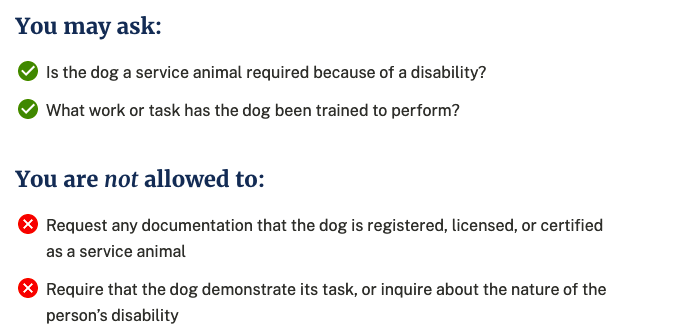
So, how does someone know if a dog is a service dog? Under the ADA, two questions may be asked of a service dog handler.
ESA’s are not recognized or protected under the ADA, since they are not trained to mitigate their owner’s condition(s).
According to the ADA National Network website, dedicated to providing assistance understanding and implementing the ADA, “While emotional support animals or comfort animals are often used as part of a medical treatment plan as therapy animals, they are not considered service animals under the ADA.”
“These support animals provide companionship, relieve loneliness, and sometimes help with depression, anxiety, and certain phobias, but do not have special training to perform tasks that assist people with disabilities,” the site continues.
Internationally, laws on service dogs vary greatly. However, there is an international governing body called Assistance Dogs International (ADI) that oversees service dog organizations all over the world.
For example, ADI lists the laws for service dogs in Canada not only as a country, but each province’s laws are also individually listed.
Although each country has their own laws regarding service animals, most recognize them in some way. This can range from only recognizing guide dogs as service dogs, to recognizing all types of service dogs such as mobility, guide, medical alert, or psychiatric service dogs.
In the US, the ADA recognized each of the types of service dogs mentioned above, along with autism service dogs and allergy detection service dogs and many others condition-specific service dogs.